My Agenda

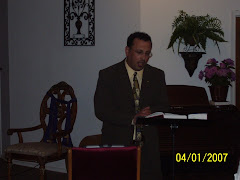
I have a two fold agenda for this blog. First, I am a devoted Christian who enjoys teaching others what I have learned, especially about the Bible. I not only have a background in cross-cultural ministry, but also includes children's ministry at both preschool and grade school leaves.

I have also worked the 12 Step of recovery in a manner in which I made them subject to Biblical principles. I am a greatfully recovering adult child of multiple dysfunctional families and a co-dependent. You will note that postings that I write dealing with this subject are categorized as Biblical Discipleship- Recovery. That term is not just propaganda on my part to win over those who are skeptical of the 12 steps. It recognizes that the Bible is the key to true "self improvement." It also reminds us that such improvements should be done for the purpose of us become more effective Christians.

The second part of my agenda of what I have learned about the prejudices that many Americans have towards Arabs since I started coming to First Arabic Baptist. The notion that all Arabs are both Muslims and Terrorist is far more prevalent then I ever realized while attending American churches. It should be noted that all of those who I have met who refuse to believe that it is possible for Arabs to choose Christianity have proven themselves to be anything but devote Christians. Pastor Jamal on the other hand will attest that there have been times when American Christians have told him that they want to support his ministry, but they are afraid that their money might be used to bomb Israelis.

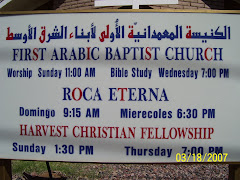
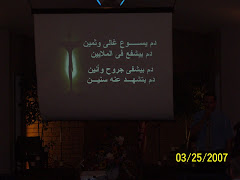
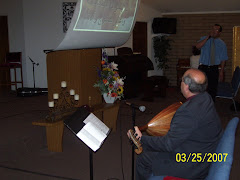
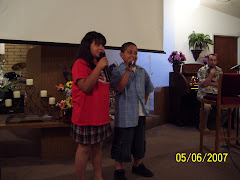
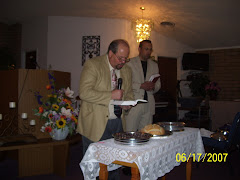
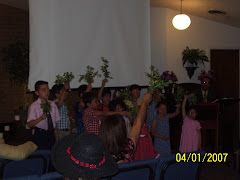
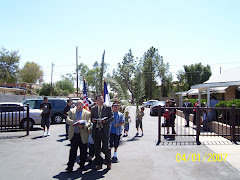
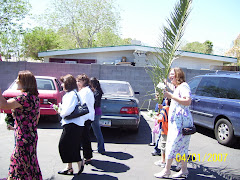
It is with this in mind that I hope to present to you First Arabic Baptist Church. A church of devoted Christians - affiliated with the Southern Baptist Convention - that conducts its services in English and Arabic - trying to do its part in fulfilling "The Great Commission".

Blog Labels

Showing posts with label Christian Discipleship-Recovery. Show all posts

Thursday, August 9, 2007

SELF-ESTEEM

Self-esteem: (Webster’s) n. 1. a realistic respect for or favorable impression of oneself; self-respect.

This definition of self-esteem seems to base on a positive self-esteem. You could say that it is a goal that all humans strive for. So why do we not reach it? Many people have a lot of different explanations for this dilemma, but I believe that I can sum up all of them in one word: Shame! The terms guilt and shame are used interchangeably in the English language, but I see this as a problem. That is because some feeling of remorse are beneficial to us and others are destructive. In the definitions that I am about to give, I will use the term guilt to describe positive remorse and shame to describe destructive remorse.

Guilt: (Webster’s) n. 2. a feeling of responsibility or remorse for some offense, crime, wrong, etc., whether real or imagined.

Shame: (Webster’s) n., v. shamed, shaming. n. 1. the painful feeling arising from the consciousness of something dishonorable, improper, ridiculous, etc., done by oneself or another: She was overcome with shame.

Guilt vs. Shame: (My view) The Webster’s definition for shame expresses a much stronger emotion then its definition for guilt. The severity of these emotions can cause long-term repercussions. Although Webster’s may not totally agree with how I expand that thought, the following is an understanding that I have received from many different sources. Guilt says you are a human being who just simply messed up. Shame says you did something terrible and even unforgivable. Guilt says you did something wrong1; but shame can lead to the belief that there is something wrong with you. We are not talking about coming to the realization that you are a sinner in need of God’s forgiveness through the shed blood of his Son. That is a Biblical understanding that we all need to come to. What we are talking about is believing that you are unworthy of forgiveness and are without hope.2 And that is a lie of Satan!

1 Romans 3:10-24, 5:12, 5:18-19

2 John 3:16-17; Romans 5:1-11, 5:15-17, 10:8-13

BOUNDARIES VS. WALLS

Boundaries: (Webster’s) n. 1. something that indicates bounds or limits; a limiting or bounding line.

(My view) Limitations set in order that all parties involved can feel safe enough to be themselves, live in peace and grow in their intimacy with each other. This is not only the order of progression for relationship with boundaries; but it is also the order of destruction for those without.

Walls: (Webster’s) n. 3. an immaterial or intangible barrier, obstruction, etc., suggesting a wall: a wall of prejudice.

(My view) Attitudes, actions and restrictions that undermine a relationship’s ability to exist. Walls keep feelings in and people out.

Boundaries vs. Walls: (My view) Setting boundaries is the first lesson that most of us co-dependents learn in recovery. We have been walked on all of our lives. We are sick and tired of being sick and tired and we are not going to take any more. So we start “setting down the rules”. But what kind of rules do we set down? What effect will these rules have on our relationship?

I have seen so many co-dependents with a controlling nature take the principles of boundaries and misuse it to justify them doing what they have always tried to do, control those around them. They wield boundaries over everybody’s heads like a sledgehammer. And if you do not tow the line, the hammer will drop. This does not bring about a safe and peaceful environment that will allow the relationship to grow in intimacy.

I will acknowledge that there are relationships that need to be severed. Those relationships that was not only a mistake to get into; but also pose such a danger to the person’s well being that they must leave for their own safety. This does not justify divorcing your spouse just because they have a list of annoying habit or a thick skull. I have noticed that the ones who are the most frustrated with their spouse’s thick skull have skulls that are just as thick. But domestic violence is another matter altogether. It is as much as a violation of the marriage covenant as adultery. Not only does the Bible command husbands to love your wives; but it also warns repeatedly that God is angered by those who oppress those who cannot defend themselves.1

1 Jeremiah 7:1-7; Amos 4:1-3; Zechariah 7:8-10; Ephesians 5:23-33; Colossians 3:19; 1 Peter 1:7

WHAT IS LOVE AND TOUGH LOVE?

“Love is patient, love is kind. It does not envy, it does not boast, it is not proud. It is not rude, it is not self-seeking, it is not easily angered, it keeps no record of wrongs. Love does not delight in evil but rejoices with the truth. It always protects, always trusts, always hopes, always perseveres. Love never fails.” (1 Corinthians 13:4-8)


Love

There are two primary Greek words that are translated as “love” in the English New Testament of the Bible: agapē and philĕō. Agapē is commonly defined by Christian as “unconditional love.” It is interesting to note that agapē is also translated as charity in 1 Corinthians 13 in the King James Version of the Bible. This expresses agapē’s willingness to give without expecting anything in return. Although just about everybody of every religious belief would agree that agapē style love is something to strive for; Christians alone realize that it can only be fulfilled to its fullest extent with God’s power working in our lives.

Philĕō is badly underrated by most Christians to the point of receiving a bad rap. It is what we feel towards those who are close to us. This would include both family and friends. A more technical definition would be “to be a friend (fond of [an individual or an object]), ie. Having affection for (denoting personal attachment, as a matter of sentiment or feeling…”1 Most Christians seem look at the prominent role that agapē plays through out the New Testament and conclude that philĕō is a second rate expression of love. After all, philĕō is an emotion and us Christians are not suppose to be guided by our emotions. But the Bible tells us that God feels philĕō for both His Son and for us.2 It also tells us that we philĕō God’s Son and that we should feel philĕō for each other.3 It should also be realized that the biggest reason that agapē is given some much prominence is because as I said earlier, it goes entirely against human nature. Philĕō on the other hand is even demonstrated by people who are in the world. This is therefore the conclusion that I have come to:

Although feeling and emotions may not be strong enough to sustain our relationships in the long term, they do give meaning to them. They motivate us in to action. It is the philĕō that I have for my family and friends that make me want to do acts of agapē. The hardest part about my loving and forgiving my enemies who I hardly know is the fact that I have no real incentive to good out of my way to make peace with them. Maybe it is someone at work or even church that I never see any other time. Or maybe a neighbor that I will only cross paths will by chance. But if it is someone who’s relationship that I value, I will loose sleep at night trying to figure out how to reconcile. I know that this is not a Biblical; but it is the way it is. Agapē may be how we save our relationship; but philĕō is why.

Tough Love

The most controversial aspect of love, from a Christian standpoint, is “tough love”. Many Christians not only refuse to believe that there is any Biblical support for such a concept, but that the entire concept its self goes entirely against scripture. They would have a strong case if it were not for the fact that their evidence is based on those who divorce much if not their entire recover program, including their understanding of “tough love”, from the Bible. Let me give you an example of a real life situation in which I advocated the use of Biblical tough love:

A lady was giving me a ride home from work one night. She told me about her moving to Phoenix in order to help out her little sitter after their mother had past away. This sister, who was in her late twenties, had been babied by their mother and had never grown up. Therefore this lady, a single parent of a seven year old, was going to take over where their mother had left off. She asked me, “Isn’t this what God would want me to do?” I asked her, “Do you believe that God wants her to grow up and be more responsible?” She replied, “Yes.” Then I ask, “Is what you are doing making it possible for her to not have to grow up?” One again she replied, “Yes.” Finally I ask her, “So is this what God what’s you to do?” See replied, “No.”

The problem that so many co-dependants have is that they hate to see people, especially their loved ones, suffer to the point that those who are irresponsible do not have to grow up. They cannot see that rescuing someone from the consequences of their own actions actually does them more harm then good. It is one thing to help someone who is struggling because of things that are beyond their control or from mistakes that they have made and have learned from and are trying to rebound from. It is another thing all together when they are suffering the repetitive consequences of their own repetitive actions, especially when these actions are blatant acts of sin.

Co-dependents are also entirely unaware of the games that irresponsible people play in order to get others to enable them. Let us take for example your typical alcoholic/drug addict. They go to their family members with a sob story about how hard up they are because of this, that and some other thing. They tell their family members that they just need a few dollars to get them by to their next paycheck so they can pay a bill or get some food. As soon as they get the money, they are off to the nearest liquor store or drug dealer. One family member after another will start seeing through their games over time and start cutting them off. As they start running out of enabling family members, they start going more and more to “friends” with their now sobbier story about how hard up they are because of this, that and some other thing. And to make matters worse, their own family does not care enough about them to help them out. They will find new enablers almost as fast as they lose the old ones.

So if they are spending almost all of their cash on drugs and alcohol, then where do they get food to eat? Having work with my churches food pantry, I can tell you from first had observation how the “career homeless”4 operates. I do not care what anyone else tells you, it is a fact that no adults go hungry in this country unless their too proud to ask for help or their motivation to take care of themselves have been wiped out by depression or hard drugs. With all of the food pantries and soup kitchen and the fact that panhandlers make more money per hour then many hard working citizens do, you do not have to worry about them going hungry. They know the system and they know how to use it the same way they use their family and “friends”. And when they do get hard up for cash, they will go to the day labor halls where they will give feeble work for feeble pay. Because they are not require to make any commitment to their employer beyond that day, they will go and work a day or two when ever they need money to by anything that can not get from the food pantries, soup kitchen and other social services. The number one idem on their list are drugs and alcohol. This is the reason that those who are professional construction workers refer to all day laborers as “rent-a-drunks”. I myself have worked day labor, so I know that everybody who does are true “rent-a-drunks;” but I also know for a fact that a notable percentage are.

So how does the Bible say that we should deal with those who choice to live in a pattern of redundant irresponsibility and sin? When Paul, in the above scripture reference instructed the church on how to deal with an immoral believer, he told them to, “...hand this man over to Satan, so that the sinful nature may be destroyed and his spirit saved on the day of the Lord.”5 He would later say, “…Hymenaeus and Alexander, whom I have handed over to Satan to be taught not to blaspheme.”6 Hand people over to Satan?! That seam kind of harsh to me! Unfortunately, that is what it takes to get though to some people. What is worse is that some people still will not learn even after such an ordeal. Do not get the idea that this in any way suggest that we should be praying curses over anyone. Handing them over to Satan simply means that we stop trying to shelter them from the consequences of their actions. A person who rejects the ways of God and follows Satan into a blatantly sinful life is on a path of destruction. We need to be praying for God’s intervention. But ultimately it will come down to them making decisions at various crossroads of live. At some point in time they will reach that final crossroad and be given that one final choice, we can only pray that it will be the right one. Some, such as the immoral believer in 1 Corinthians 5:1-5, do finally repent. It is believed by many, including myself, that he is the one the Paul refers to in 2 Corinthians 2: 3-11. Paul then instructs the church to:”…reaffirm your love for him...in order that Satan might not outwit us. For we are not unaware of his schemes.

The concept of tough love is something that many co-dependents are too eager to embrace. Those who were doormats are more than happy to free themselves, while those who have always been controlling and manipulative find justification for doing what comes naturally. That is because most people in recovery are taught this concept absent of the guidance of the Bible.

The first time I tried to use what I called “tough love”, it was in order to get a friend to change into what I wanted her to be. The Holy Spirit convicted me by calling it “emotional blackmail.” I tried to use our friendship as leverage to get her to come out of her co-dependent denial. If she would not change then it would be unhealthy for me to remain friends with her. I tried justifying this attitude by believing that I was doing this for her own good; but the fact was that was doing it to get my own wants met. I had romantic intensions towards her and wanted her to take away my loneness. She was afraid of getting close to people so she tried to get her needs met be trying to meet everybody else’s needs. Yes, her behavior was defiantly dysfunctional; but my agenda for confronting her was just as bad.

A lot of what I have seen done in the name of “tough love” would best be described as blackmail. If our significant others does not straighten up and fly right, then they are going to suffer the consequences. After all, their significant others are the cause of most of their problems; and so they cannot fix their own problems until after their significant others change. This is a bogus notion that nearly every co-dependant embraces early on in their recovery. Some of them never give it up!

Some of the demands for change do not even involve unhealthy behaviors. Sometimes it is a matter of the person who is applying the “tough love” is just intolerant of the differences in others. They have a self-righteous, judgmental standard for what is and is not appropriate behavior that they expect everyone to conform to. This too is an unbiblical usage of tough love.

1 Strong's Bible Concordance, Greek Dictionary of the New Testament, ref. #5368

2 John 5:20, 16:27; Revelation 3:19

3 John 16:27; Romans 12:10; Titus 2:4, 3:4, 3:15, Hebrews 13:1; 1 Peter 1:22, 3:8; 2 Peter 1:9

4 Note that there is a big difference between someone being homeless because of bad breaks or choices that they have learned and grown from, and someone who makes a career out of being homeless.

5 1 Corinthian 5:5

6 1 Timothy 1:20

THE RIVER CROSSING

I hiked the Wind River Mountains in Wyoming with my Boy Scouts troop back when I was 14. During the hike, we came to a river that we would have to wade across. My Dad, who was volunteering to help out on the hike, found a spot that was shallow enough for us to wade across safely. We were given clear instructions before we started, “cross against the current.” But as I look up stream, I saw how fast the current was and thought to myself, “that looks too hard.” I tried picturing myself trying to push myself, one foot at a time, against the force of the river. It seemed like it would be too hard to do. I looked down stream and knew that crossing with the current would be a mistake. Then I looked straight across, and the current just did not seem so strong. So I decided to ignore the orders of my Dad, Scout Master and all the other adults with us that day.

When my turn came, I started to take a straight path across the river! As I did, everybody on both sides were yelling for me to cross against the current; but I thought, “I will show them, this is so much easier.” Just before I got out to about waist high, my foot slipped; but I quickly regained my balance. I thought to myself, “Hah — I caught myself!” But everyone continued to yell for me to cross against the current! Then I took the next step; actually I tried to take my next step. As I extended my left leg, the force of the current pushed it down stream of my right leg! At that time my legs were crossed! Everyone continued to yell to me and then I thought that maybe I should listen. I quickly repositioned my right leg to regain my balance; but before I could find a good spot to set it, the force of the river pushed my left leg down stream again! Quick I tried to reposition my right leg; but then the force of the current did it again! This time I had no chance to recover. The force of the current pushed me over side ways and began to carry me down stream. Fortunately, one of the older scouts jumped in immediately and pulled me to shore.

Two or three days later, we had to cross another river. Again my Dad found a spot shallow enough for us to cross at. Again we were instructed to cross against the current. This time I followed directions. It was strenuous pushing one foot at a time directly into the force of the current; but it did not take me long to realize something. Crossing against the current put my body in a Poisson that give me the stability to stand my ground. I finally crossed the river, I was a little bit fatigued in my legs; but I was dry from the waist up.

When we confronted with adversity in life, we try our hardest to avoid dealing with it head on. After all, there is just so must stress involved in dealing with such situation. So we try to find what appears to be an easier rout. But the adversity keeps coming and our attempts to avoid it have left us in a position to where we cannot take steps to alleviate them. We wind paying the price in the end in the form of the weakening or even total lose of our family relationships, friendships, goals, dream, joy, serenity, sobriety and even our sanity. Then we turn around and blame the people and circumstances involved in the adversity for all our misery. Or we act like we are bullet proof, “it is all water under the bridge,” we tell our selves and others. But this is far from accurate; it is actually water over our heads!

SWIMMING LESSONS

I took a survival swimming course shortly after graduating from high school. We were taught how to do the, “survival bob.” If we were ever stranded in the water and needed to buy time for help to arrive, we would go threw repetitive cycle of relaxing our arms allowing ourselves to sink below water for a few seconds so we can rest them, and then paddle our way back above water for a few seconds to get more oxygen. By doing this, you are supposed to be able to survive out in the ocean for several days.

I am to this day a poor swimmer, so my instructor and I thought it would be good for me to send my free time practicing basic swimming. So while he would be busy with some one else or just relaxing, I would push myself as far out as possible from the side of the pool in front of him at the deep end and practice swimming back. I did this several times in a row and then decided to do it just one more time. That was one more time then my arms had the strength to pull me back.

I quickly calmed myself and went into the “survival bob” routine that I had just been taught. I rested my arms, and after being underwater for a few second, I started paddling myself back above water. The instant my head broke the surface, I calmly called out for help; but my arms were fatigued again. And so I rested them long enough to get some straight back in them and then shot back to the. This time I knew my instructor would be read for me.

As soon as broke the surface, I heard him say, “Jason, over here!” I could not see him because of all the splashing I was doing, but I heard were the voice had come from. I reach out in that direction and then felt my wrist being grabbed and then me being pulled. After I was back holding the side of the pool, my instructor commended me for my efforts.

Life is full of growth and challenges. God is pleased when we step out and take risks that will improve our relationship with Him and all that He has created. God wants us to strive for these noble goals that He has placed in our hearts. This is how He transforms us into the image of his Son. And when we fall short, He will always be right there to get us out of our jams. He will not condemn us for not meeting these goals; but instead He will commend us for our obedience and courage.